
CENTRALE LYON - PhD Numerical simulation of wind turbine noise propagation in the environment accounting for three-dimensional effects
- On-site
- Ecully, Auvergne-Rhône-Alpes, France
- €27,600 - €27,600 per year
- LMFA - Laboratoire de Mécanique des Fluides et d'Acoustique
Job description
ECL and Laboratory presentation
Founded in 1857, École Centrale de Lyon is one of the top 10 engineering schools in France. It trains more than 3,000 students of 50 different nationalities on its campuses in Écully and Saint-Étienne (ENISE, in-house school): general engineers, specialized engineers, masters and doctoral students. With the Groupe des Écoles Centrale, it has three international locations. The training provided benefits from the excellence of the research carried out in the 6 CNRS-accredited laboratories on its campuses, the 2 international laboratories, the 6 international research networks and the 10 joint laboratories with companies. Its excellent research and high-level teaching have enabled it to establish double degree agreements with prestigious universities and advanced partnerships with numerous companies. With its focus on sobriety, energy, the environment and decarbonization, Centrale Lyon intends to respond to the problems faced by socio-economic players in the major transitions.
Numerical simulation of wind turbine noise propagation in the environment accounting for three-dimensional effects
Context
The European Green Deal aims to achieve climate neutrality across the continent by 2050. In this context, the development of renewable energy sources represents a major challenge. In particular, wind energy is expected to account for approximately 50% of the energy mix by that time.
However, noise generated by onshore wind farms remains a significant barrier to their deployment. It is a source of annoyance for nearby residents [1] and can also impact biodiversity [2]. As a result, current regulations may require certain installations to operate at reduced capacity, significantly lowering their efficiency. These constraints also complicate the selection of suitable sites for new wind farms.
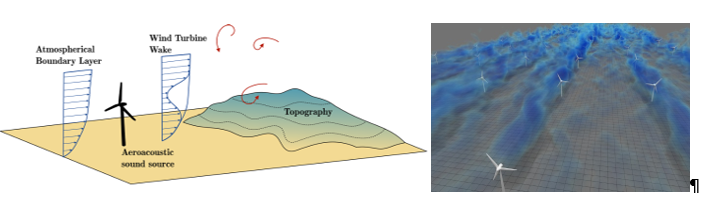
Figure 1 – (Left) Schematic of the mechanisms affecting atmospheric flow and the propagation of noise emitted by a wind turbine [3], and (right) flow field simulated using a LES approach in a wind farm, with low-velocity regions [4].
In this context, accurately predicting the propagation of wind turbine noise in the atmosphere is essential to better understand the underlying physical mechanisms and to conduct reliable acoustic impact assessments at the design stage. As illustrated in Fig. 1, several factors must be considered. Meteorological effects, such as variations in wind, turbulence, and temperature with altitude, have a strong influence on sound propagation. In addition, the presence of the wind turbine alters the atmospheric flow, as shown in Fig. 1. Furthermore, topography and ground impedance can have a significant impact, both on the flow and on the reflection of acoustic waves at the ground.
Predicting wind turbine noise therefore relies on numerical simulations. Numerous numerical methods have been developed to model acoustic propagation in the atmosphere. The state of the art in wind energy applications [3,5] is largely based on the parabolic equation, an efficient method for modeling acoustic propagation along a preferred direction. However, existing models are generally limited to a two-dimensional (2D) approach, considering propagation in the vertical plane containing the source and the receiver, to reduce the computational cost of the simulations. This approximation neglects transverse propagation effects, which is a strong assumption given the inherently three-dimensional (3D) nature of the flow around a wind turbine. Recently, we conducted a first study, limited to low frequencies [6], highlighting the importance of three-dimensional effects in the wake of a wind turbine.
2. Description of the work
The objectives of the PhD are threefold.
First, it aims to develop a reference numerical model for the propagation of wind turbine noise in the atmosphere. This model will be based on a 3D parabolic equation using a formulation adapted to sound propagation in a moving and inhomogeneous atmosphere recently proposed in the literature [8]. It will incorporate an aeroacoustic source model for the wind turbine [9] and will integrate data from large-eddy simulations for the atmospheric flow [4].
Second, once the model has been validated on test-cases, comparisons will be performed with in situ measurements from a wind farm in collaboration with CEREMA [10].
Third, the model will be applied to investigate three-dimensional propagation effects arising in wind turbine noise context, including the effect of the three-dimensional flow around the wind turbine.
These results will be used to provide recommendations to improve operational models employed in noise assessment studies for wind farms.
3. References
[1] M. Pawlaczyk-Łuszczyńska, K. Zaborowski, A. Dudarewicz, M. Zamojska-Daniszewska, and M. Waszkowska. Response to noise emitted by wind farms in people living in nearby areas. International Journal of Environmental Research and Public Health, 2018.
[2] L. Hanna, L. Feinberg, J. Brown-Saracino, F. Bennet, R. May, and J. Köppel. Results of IEA wind adaptive management white paper. Technical report, International Energy Agency Wind Implementing Agreement, 2016.
[3] Colas, J., Emmanuelli, A., Dragna, D., Blanc-Benon, P., Cotté, B. & Stevens, R.J.A.M., 2024, Impact of a two-dimensional steep hill on wind turbine noise propagation, Wind Energy Science, 9, 1869-1884.
[4] R. J. A. M. Stevens, D. F. Gayme, and C. Meneveau. Effects of turbine spacing on the power output of extended wind-farms. Wind Energy, 19(2) :359–370, 2015.
[5] W. Z. Shen, W. J. Zhu, E. Barlas, and Y. Li. Advanced flow and noise simulation method for windfarm assessment in complex terrain. Renewable Energy, 143 :1812–1825, 2019.
[6] B. Kayser, Gauvreau B, and D. Ecotière. Sensitivity analysis of a parabolic equation model to ground impedance and surface roughness for wind turbine noise. Journal of the Acoustical Society of America, 146(5) :3222–3231, 2019.
[7] H. Bommidala, J. Colas, A. Emmanuelli, D. Dragna, C. Khodr, B. Cotté, and R. J.A.M. Stevens. Three-dimensional effects of the wake on wind turbine sound propagation using parabolic equation. Journal of Sound and Vibration, 608 :119036, 2025.
[8] V. E. Ostashev, J. Colas, D. Dragna, and D. K. Wilson. Phase-preserving narrow- and wide-angle parabolic equations for sound propagation in moving media. Journal of the Acoustical Society of America, 155(2) :1086–1102, 02 2024.
[9] Tian, Y. and Cotté, B.: Wind Turbine Noise Modeling Based on Amiet’s Theory: Effects of Wind Shear and Atmospheric Turbulence, Acta Acust. united Ac., 102, 626–639.
[10] PIBE project, Database from the long-term measurement campaign, cerema-med.shinyapps.io/pibe-app/
Job requirements
Required skills / qualifications________________________________
Diplomas: master’s degree or equivalent (engineering diploma) in acoustics, mechanical engineering, physics, or a related field.
Experience: none required.
Knowledge required: background in acoustics, fluid mechanics, aeroacoustics, and numerical methods.
Operational skills: hands-on experience with computing in C/C++, Fortran, Python, or similar programming languages; excellent written and verbal communication skills in English.
Behavioural skills: autonomy, curiosity, initiative, and ease of interpersonal communication.
Work context / environment_______________________________
This PhD work is within the French project EOPE (Évaluation des modèles Opérationnels pour la Prévision du bruit des Éoliennes en environnement réaliste) funded by the French agency for ecological transition ADEME. EOPE is a collaborative project between Centrale Lyon, CEREMA, and University of Twente, which aims to develop a reference numerical model for wind turbine noise propagation and to provide recommendations to improve the operational models used in engineering consultancies.
The PhD will be directed by D. Dragna, assistant professor at LMFA, Ecole Centrale de Lyon, and co-supervised by R. J. A. M. Stevens, professor at the University of Twente.
Recruitment process_______________________________
The recruitment process takes place in two stages, supervised by a recruitment committee, in accordance with Centrale Lyon's OTMR policy.
Study of the written application: CV, cover letter, and academic transcript
Selection interview: in person or by videoconference
Recruitment timetable:
Application deadline: June 15, 2026
Selected candidates will be interviewed until June 22, 2026
Ranked list of candidates: June 26, 2026
Selection criteria: Relevance to the job profile
or
All done!
Your application has been successfully submitted!
You've already applied for this job
We appreciate your interest in this position. Unfortunately, you have already applied for this job.