
CENTRALE LYON - Postdoc position in AI for the study of mixed polymer brushes with applications in biomedicine and tribology
- On-site
- Ecully, Auvergne-Rhône-Alpes, France
- €2,575 - €2,868 per month
- INL - Institut des Nanotechnologies de Lyon
Job description
Research context
The deposition of polymer brushes on solid surfaces creates versatile platforms for a wide variety of practical applications in biomedicine, nanotechnology, catalysis, photovoltaic devices, water conversion and storage, as well as certain functions designed to reduce energy costs.
Depending on the chemical composition of the polymers and the associated liquid environment, polymer brushes can be adapted to a specific application [1].
Atomic force microscopy (AFM) is used to characterize these different polymer brushes. In its spectroscopic mode, AFM can measure the interaction forces between its tip and the grafted polymer brush. The force curves provide information on the influence of the liquid (ionic strength, pH, hydrophobicity, viscosity, etc.) on the conformation of the polymers.
Since the process is stochastic, a very large number of force curves must be produced to characterize a polymer/liquid system. A measurement consists of a force map generally comprising 1,024 curves (32 curves/line x 32 lines) over an area of, for example, 25 nm x 25 nm (Figure 1). To ensure the consistency and reliability of our data, five measurements are taken for each sample at different locations on the surface in several solutions. The measurements are also repeated on other identical samples in different liquids, ultimately yielding a dataset of approximately 300,000 curves.
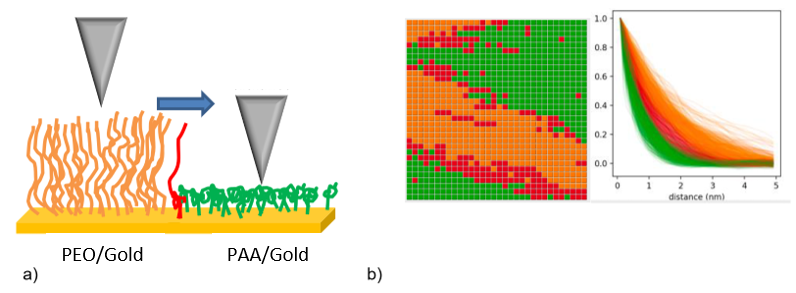
Figure 1 : a) Model of an AFM tip approaching a Polymer/Gold surface ,PEO (in orange) PAA (in green) in a HCl + NaCl solution, b) Force map of 32 x 32 pixels covering a 25nm x 25 nm area ( each pixel is a curve) and the 1,024 corresponding curves.
This research, thanks to its future applications in biomedicine and tribology, is fully in line with the Sustainable Development Goals (SDGs):

and to a lesser extent

and

because the biosensors created from these polymers can also be used to capture and store atmospheric water (another project currently underway).
Description of the research project
The postdoctoral research project aims to develop new Artificial Intelligence models for the analysis of large datasets of force curves. The goal is to extract properties that will enable the characterization of polymer/liquid systems.
More concretely, the first step will consist in designing a rich yet compact representation of the force curves to serve as input to AI models [2]. These models will then be developed to extract knowledge embedded in the data, using descriptive approaches such as clustering, as well as to predict physical properties from the curves through supervised learning methods based on neural network architectures [3], trained on a dedicated dataset of force curves to be constructed.
By leveraging these models, it will become possible to better understand the properties of polyelectrolyte polymers and their interactions with the liquid environment, and to automatically predict the configurations to consider depending on the type of biosensor targeted for a given application.
This multidisciplinary project involves three laboratories at Centrale Lyon:
LTDS: https://ltds.ec-lyon.fr
LIRIS: https://liris.cnrs.fr/en
This position is a 1-year full time postdoctoral position with a monthly gross salary of 2,575 to 2,868 € depending on the previous experiences.
References
[1] A. Kiełbasa, K. Kowalczyk, K. Chajec-Gierczak, J. Bała and S. Zapotoczny, Applications of surface-grafted polymer brushes with various architectures, Polym Adv Technol. 2024; 35: e6397. DOI:10.1002/pat.6397
[2] Sotres, J., Boyd, H. & Gonzalez-Martinez, J.F. Locating critical events in AFM force measurements by means of one-dimensional convolutional neural networks. Sci Rep 12, 12995 (2022). DOI :10.1038/s41598-022-17124-z
[3] Masud, N., et al. Machine learning approaches for improving atomic force microscopy instrumentation and data analytics. Frontiers in Physics, 2024, 12, 1347648. DOI: 10.3389/fphy.2024.1347648/full
Job requirements
Job requirements
Required skills / qualifications
Diplomas: PhD in Computer Science
Knowledge required: Contributions in the Artificial Intelligence / Machine Learning domains.
Research mindset: great scientific curiosity and strong interest in applications in materials science.
Operational skills: advanced skills in Python and ML libraries (e.g., PyTorch and Scikit-learn), writing scientific reports and articles, presenting at scientific conferences.
Behavioral skills: Independence, ability to work in a team and adapt to the needs of colleagues, creativity
Recruitment process
The recruitment process takes place in two stages, supervised by a recruitment committee, in accordance with Centrale Lyon's OTMR policy.
Study of the written application: a detailed CV including a list of publications, a motivation letter and the names and contact information of at least two academic references.
Selection interview: in person or by videoconference
or
All done!
Your application has been successfully submitted!