
CENTRALE LYON - PhD Effects of the Hofmeister ions series on the adsorption of sepsis metabolites on a gold layer. Molecular dynamics simulations study enhanced with a validation by surface plasmon resonance analysis. Application to sepsis diagnosis
- On-site
- Ecully, Auvergne-Rhône-Alpes, France
- €27,600 - €27,600 per year
- INL - Institut des Nanotechnologies de Lyon
Job description
Background:
Sepsis is a blood infection, often of bacterial origin. It is the leading cause of preventable death in developed countries. Currently, it takes several days to diagnose the disease because bacteria can be present in very low concentrations in the blood. However, patients' chances of survival can decrease by the hour. Thus, there is an urgent need for a diagnostic tool that can provide results in just a few minutes. A range of blood metabolites have been identified as biomarkers of sepsis. However, metabolites are low molecular weight molecules embedded in the blood among an abundance of nonspecific molecules. Their detection isstill a challenge.
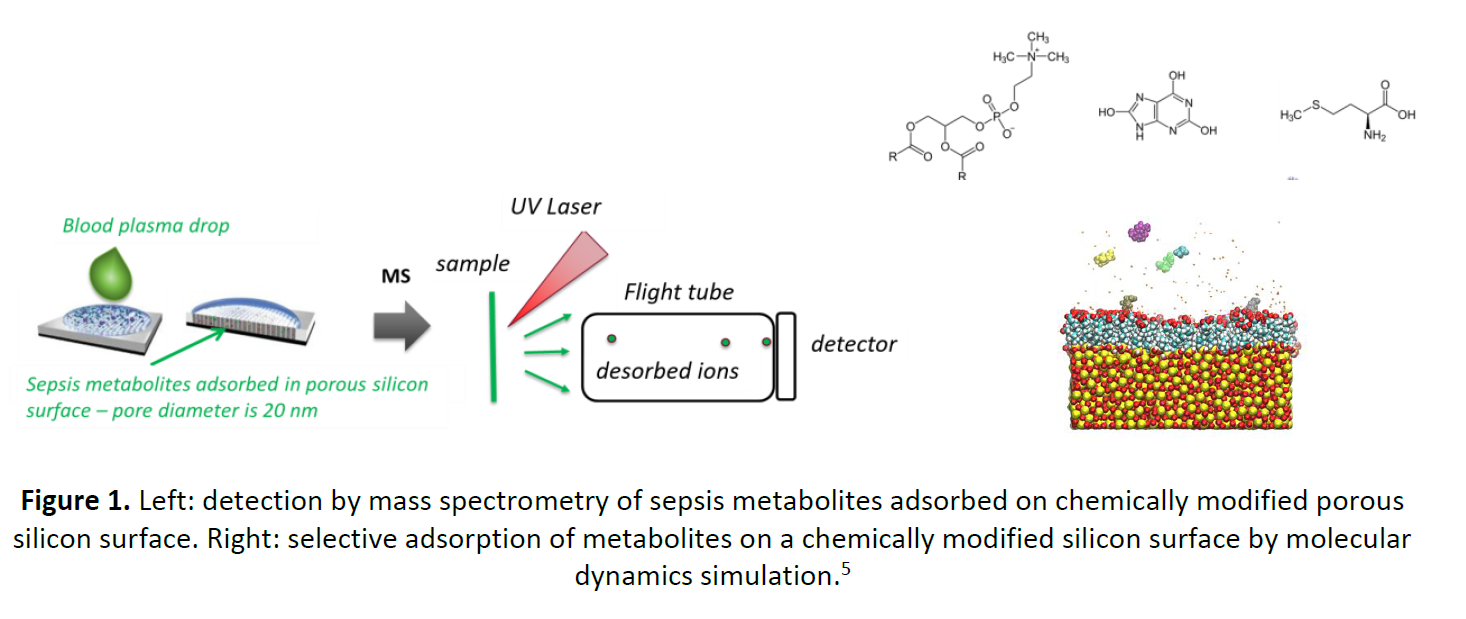
The INL laboratory has been working since 2021, on the modeling of the impact of chemical modification of surfaces on the adsorption of metabolites, from fluid samples, and their subsequent detection by mass spectrometry, by combining molecular dynamics simulations and experiments(Figure 1). 1-5 The present PhD thesis will investigate the effects of additional specific ions in fluid samples (Hofmeister ions series) on the organization of interfacial water molecules and metabolites adsorption on gold surfaces.3,6,7
Research subject/work plan:
The principal objective of the thesis is to model the intermolecular interactions between metabolites and a chemically modified gold surface in the presence of different ions. Molecular modeling will be performed with Ecole Centrale de Lyon cluster “Newton”, with the classical OPLS force field. The first step will be the identification, by all atoms molecular dynamics simulations, of ions able to improve the specific adsorption of a panel of sepsis metabolites, on chemically modified gold8 surfaces. The effects of ions on the organization of interfacial water molecules will be investigated, as well as the impact of the organization of water molecules on the selective adsorption of metabolites depending on their physicochemical properties. Simulation results will be assessed by experimental surface plasmon resonance (SPR) analysis on gold surfaces. The student will develop a data analysis method (e.g. statistical methods) to identify the main parameters driving metabolite-surface interactions in the presence of different concentrations and ratio of ions.9 If time permits, mass spectrometry analysis will be carried out through collaborations to assess the method within a clinical framework. 3
Scientific environment:
The PhD student will be supervised by Dr Christelle Yeromonahos (specialist of molecular dynamics simulations) and Prof. Jean-Pierre Cloarec (specialist of surface plasmon resonance) at the INL lab. The Chemistry and Nanobiotechnology group, at INL, is conducting interdisciplinary research activities on coupling numerical methods, nanotechnology and molecular biology for health and environmental applications.
References:
1- Solène Lecot, Yann Chevolot, Magali Phaner-Goutorbe, Christelle Yeromonahos. Impact of Silane Monolayers on the Adsorption of Streptavidin on Silica and Its Subsequent Interactions with Biotin: Molecular Dynamics and Steered Molecular Dynamics Simulations. Journal of Physical Chemistry B, 124, 6786 – 6796, 2020
2- Solène Lecot, Antonin Lavigne, Zihua Yang, Thomas Géhin, Claude Botella, Yann Chevolot, Magali Phaner-Goutorbe, Christelle Yeromonahos, Arrangement of Monofunctional Silane Molecules on Silica Surfaces: Influence of Alkyl Chain Length, Head-Group Charge, and Surface Coverage, from Molecular Dynamics Simulations, X-ray Photoelectron Spectroscopy, and Fourier Transform Infrared Spectroscopy. Journal of Physical Chemistry C, 124, 20125-20134, 2020
3- Solène Lecot, Antonin Lavigne, Zihua Yang, Yann Chevolot, Magali Phaner-Goutorbe, Christelle Yeromonahos. Effects of the Chemical and Structural Properties of Silane Monolayers on the Organization of Water Molecules and Ions at Interfaces, from Molecular Dynamics Simulations. Langmuir, American Chemical Society, 37, 5563-5572, 2021
4- Solène Lecot, Yann Chevolot, Magali Phaner-Goutorbe, Christelle Yeromonahos, Curious Binding Energy Increase between the Receptor-Binding Domain of the SARS-CoV-2 Spike Protein and AngiotensinConverting Enzyme 2 Adsorbed on a Silane Monolayer from Molecular Dynamics Simulations. Journal of Physical Chemistry B, 125, 11078-11090, 2021
5- A. Lavigne, T. Géhin, B. Gilquin, L.E. Xerri, M. Veillerot, V. Jousseaume, Y. Chevolot, M. Phaner-Goutorbe, C. Yeromonahos. Effects of the physico-chemical properties of amino acids and chemically functionalized surfaces on DIOS-MS analysis. Anal Biochem. 2025, 30; 700:115792. 4
6- Sarathi Kundu, Sanu Sarkar, Reverse Hofmeister effect on bilayer adsorption of Lysozyme, AIP Conf Proc, 0248639, 2025.
7- Marat Andreev, Alexandros Chremos, Juan de Pablo, Jack F. Douglas, Coarse-Grained Model of the Dynamics of Electrolyte Solutions, J. Phys. Chem. B, 121, 34, 8195–8202, 2017.
8- Xiao Li, Jie Tan, Jiekai Yu, Jiandong Feng, Aiwu pan, Shu Zheng, Jianmin Wu, Use of porous silicon-gold plasmonic nanostructure to enhance serum peptide signals in MALDI-TOF analysis. Analytical Chimica Acta, 849, 27-35, 2014.
9- Oliver T. Unke et al. Biomolecular dynamics with machine-learned quantum mechanical force fields trained on diverse chemical fragments. Sci. Adv.10, eadn 4397(2024)
Job requirements
Candidate skills:
The PhD candidate should ideally have a background in engineering sciences, material sciences or physical chemistry. A culture in computer science, numerical simulations and data analysis via Python or Matlab is required. Knowledge about computational chemistry, and High-Performance Computing on datacenter would be a plus. Also, the candidate must be able to work at the interface between chemistry, mathematics, and physics. An interest for experimental chemistry and surface plasmon resonance is required.
Funding:
In the framework of the “Ecole Doctorale Matériaux”, the candidate will apply in April 2026 to a PhD grant beginning in October 2026 for 3 years. In complement to this grant, the candidate can also participate to the teaching of ECL’s students if desired.
or
All done!
Your application has been successfully submitted!
You've already applied for this job
We appreciate your interest in this position. Unfortunately, you have already applied for this job.